Making the Invisible Visible
Through her work on PFAS—the “forever chemicals” found in countless everyday products—Alissa Cordner reveals the interplay of politics, science and sociology
By Tara Roberts
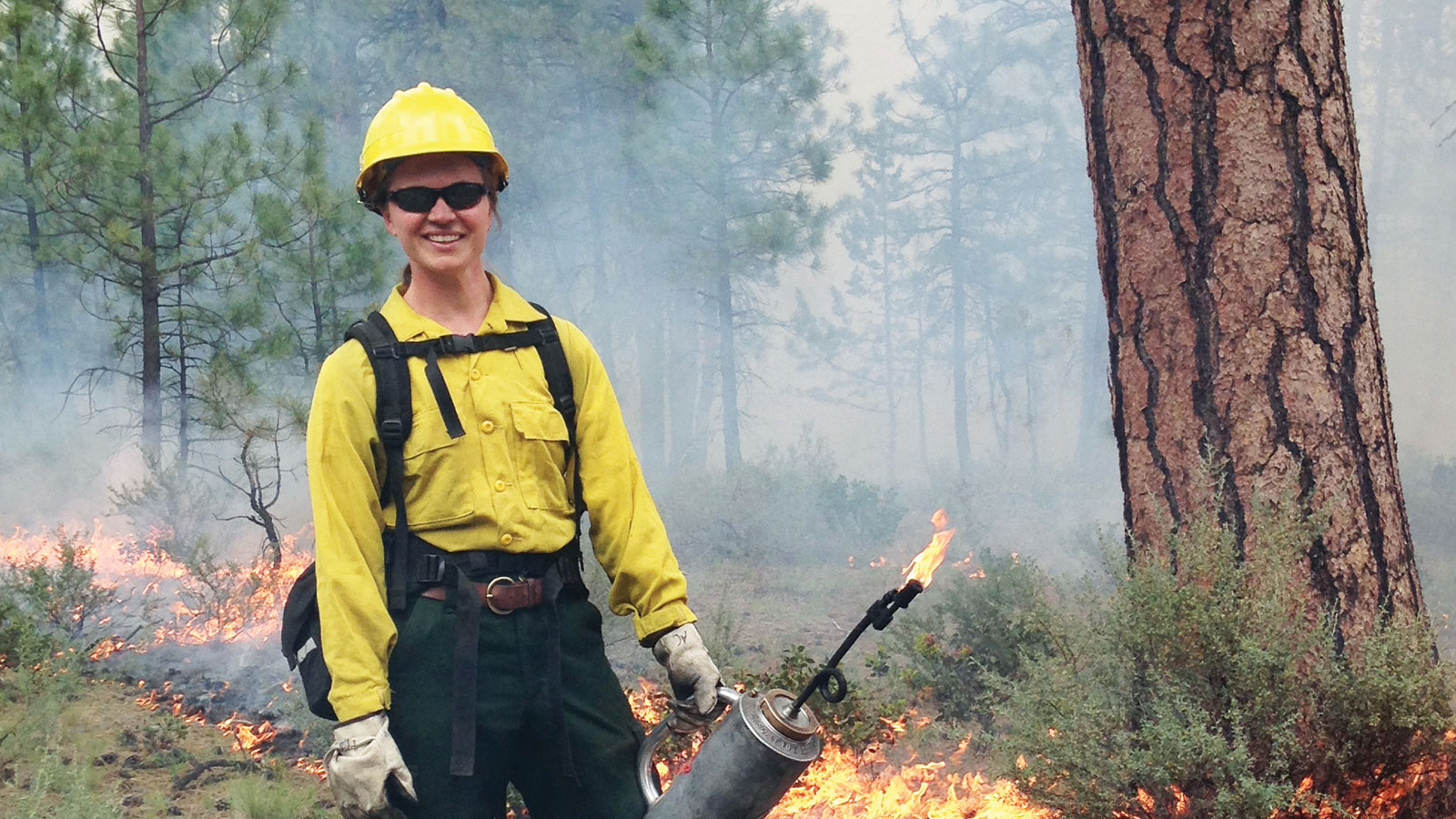
When Alissa Cordner responds to a wildland fire as a Walla Walla County volunteer firefighter, her mind often connects back to her research at Whitman.
Cordner is an associate professor of sociology and an internationally recognized expert on PFAS—per- and polyfluoroalkyl substances. PFAS are a class of thousands of synthetic chemicals that scientists have linked to myriad health problems, including cancer and fertility issues. They’re used across modern industrial processes and products, including to make items non-stick, waterproof, stain-resistant and fire-retardant.
Cordner’s wildland firefighting gear is likely low in PFAS, and the substances used to put out wildland fires don’t typically contain them. But when she responds to fires across the county or trains with other District 4 firefighters, she’s surrounded by crews who typically focus on structure fires. Their PFAS story is different.
{{1-right}}
Structure firefighters are exposed to “a toxic chemical cocktail,” Cordner says. High levels of PFAS can be found on their gear, in their personal protective equipment and in the foams they use to put out fires.
“The fire community is so focused on public safety and taking substantial risks in order to save the lives of other people,” Cordner says. “It is just so unfair that they have been exposed to really high levels of PFAS and other toxic chemicals, just in the course of doing their work.”
While firefighters have high levels of occupational exposure, no one is exempt from PFAS. Studies have shown that 98% of Americans have PFAS in their bodies. And those chemicals don’t break down easily. PFAS are dubbed “forever chemicals” because they can remain in the human body for a lifetime, and in the environment for thousands of years. Probably most concerning is that in some communities, often in industrial, agricultural and lower-income regions, PFAS seep into the drinking water—affecting all the population.
Cordner’s work involves breaking down PFAS in a way that is possible: by understanding how the situation became so dire, laying out the realities of the problem, and giving regulators, community leaders and everyday people the tools they need to understand and reduce PFAS contamination—and point the world in a healthier direction.
How Did We Get Here?
It’s a familiar story: a material is discovered, companies find a multitude of uses for it and problems arise later. By then, the material is ubiquitous. The government might restrict it, but rarely bans it. For instance, lead is still used in ammunition and some batteries.
“It’s not as though once something is dangerous, we stop using it,” Cordner says. “That’s just not how our system works.”
The fact that these compounds are used in consumer products and manufacturing processes means they don’t have to be there. It’s possible to create meaningful change.—Alisssa Cordner
PFAS are even more complicated because they are a class of thousands of chemicals, not a single material. The first PFAS chemicals were synthesized in the 1930s, which led to PFAS-containing commercial products, such as Teflon, in the 1940s and ’50s.
Researchers began documenting PFAS toxicity in the 1960s. While some types have been phased out or restricted over the years, Cordner says, manufacturers often replace them with another type of PFAS.
“It’s not as simple as, ‘We found this one chemical that’s the problem, we’ll just pull it off the market and we’re good to go,’” she says. “It’s a much more complicated story of chemical use and substitution.”
What Is the PFAS Project Lab?
Cordner’s research has focused on toxic chemicals throughout her career. Shortly after joining the Whitman faculty in 2013, she and Phil Brown of Northeastern University founded the PFAS Project Lab.
With a grant from the National Science Foundation, they set out to explore the intersections of social, scientific and political factors related to PFAS.
“We had decades of knowledge that these chemicals were toxic, and that they were highly persistent, that they were bioaccumulative—in the human body, they didn’t break down,” Cordner says. “Why do we see such an uneven relationship between scientific discovery and then some sort of meaningful action to protect public health?”
{{2-right}}
The PFAS Project Lab now includes researchers from several nonprofits and institutions, including Rosie Mueller, an assistant professor of economics at Whitman.
One of the lab’s goals is to gather scientific and regulatory data and make them more accessible. This includes an interactive map showing hundreds of known PFAS contamination sites, community resources and state regulatory actions.
But some important PFAS-related data doesn’t exist. Most states don’t test drinking water or potentially contaminated sites for PFAS, and those that do may test in different ways. There is currently no federal standard for PFAS in drinking water that would require testing.
To address this, Cordner and her colleagues examined existing studies linking certain types of facilities to PFAS contamination, then created a map of more than 57,000 sites of presumptive contamination.
These include industrial facilities, wastewater treatment plants, military sites and more—including 519 airports, because the FAA requires training with fluorinated firefighting foam.
“We’re not saying that every single one of these sites is contaminated,” Cordner says. “However, we’re saying that if you don’t have data that says they’re not contaminated, you should proceed as though they are.”
{{3-left}}
Cordner said she and her colleagues strove to make their work detailed and transparent, so it’s replicable and useful. They share their data with researchers, regulators, community groups and anyone willing to take action.
“One of the major goals of our research in general is making information available to folks, so that they are better informed about the potential environmental risks around them to make them better able to advocate for what they want in terms of their own health.”
Groups who advocate for environmental justice and equity could also use the data, Cordner says. For example, advocates could identify presumptive sites on tribal reservation land or near other communities that are disproportionately affected by pollution.
How Are Whitman Students Helping?
Cordner’s students are also working members of the PFAS Project Lab team. Their education gives them valuable skills for studying such a complex issue, she says.
“The liberal arts model that we have at Whitman does such a wonderful job of building students’ critical thinking, their ability to evaluate data, their ability to understand how arguments are developed, and therefore where we might see bias or conflicts of interest,” she says.
In turn, the research experience benefits the students.
Senior Daniel Bloor, a sociology-environmental studies major from Santa Ana, California, spent the summer of 2022 as an undergraduate research assistant for Cordner and is extending his work into his senior thesis. He made a database of how PFAS is defined in legislation and is examining why states use different definitions.
Attending a conference in North Carolina showed him how his research reaches beyond the lab.
“I got to see stories from scientific experts, social science experts, activists and people who have been personally affected by PFAS,” Bloor says. “Hearing those stories made me see a lot more of what chemicals can do to people and families.”
Anna Allgeyer ’22 also turned her research with the lab into her senior thesis, which focused on “regrettable substitution”—when a company removes a harmful chemical but replaces it with one that is less-studied, but potentially just as harmful.
Allgeyer’s research helped direct her focus toward environmental policy, and she recently started a fellowship in the Environmental Protection Agency’s Office of Water in Washington, D.C. While she’s not exactly sure where her career will go from here, her experience taught her that research can lead to change.
“Getting to work with Dr. Cordner and the PFAS Project Lab really gave me insight into how change happens both at the federal level and state level,” Allgeyer says. “It gave me a lot of real-world experience that was bigger than Whitman and opened my eyes to the real world of environmental problem solving.”
What Could the Future Hold?
A few major changes in PFAS regulation in the United States are on the horizon.
The federal government is expected to define maximum water contaminant levels for two types of PFAS, Cordner says—which means everyone whose drinking water comes from public water systems should have regular testing for those two chemicals in a few years.
While this is a step in the right direction—the two types, PFOA and PFOS, are not in the majority of PFAS being produced in the United States anymore. PFOA and PFOS are also proposed for the Superfund program’s hazardous substances list, which Cordner says could have big implications for the overall classification of PFAS.
Cordner and her colleagues at the lab would like to see the world adopt an “essential use framework” approach to PFAS.
“We think that regulatory and legislative efforts should target PFAS as a chemical class and should really be targeting stopping the ongoing uses and preventing any new uses of PFAS pretty much across the board, with maybe a few small exceptions for uses that are truly seen as necessary for the functioning of society, and for which there is no safer alternative,” she says.
There are reasons for optimism going forward. For one, Cordner says, people affected by PFAS have become central to regulatory processes and scientific research.
“In the last couple of years, you see a much greater recognition of the importance of including the voices and perspectives and experiences of those who are highly impacted by contamination. This is really a model for other environmental health issues that have a community impact.”
For hope and motivation in her own research, Cordner references biologist Sandra Steingraber, who is a cancer survivor and an expert on environmental links to cancer and human health. Cordner uses Steingraber’s book,“ Living Downstream,” in her Environmental Health class, a 300-level environmental studies and sociology class to help her students understand the scope and gravity of the chemicals in our everyday lives.
“Steingraber talks about how it’s actually very hopeful that so many of our concerns about environmental causes of cancer or other health impacts have really direct human causes, because then we can change them,” Cordner says. “The fact that these compounds are used in consumer products and manufacturing processes means they don’t have to be there. It’s possible to create meaningful change.”
