A Grand Finale
Collaboration, critical thinking, creativity, research, analytical skills and writing, writing, writing.
By By Jodie Nicotra and Emily Solomon ’21
It might sound like a rundown of the top human skills demanded by the 21st-century workplace. But these elements are also at the heart of Whitman College students’ most challenging assignment of their college careers: the senior thesis.
More than two-thirds of academic departments at Whitman require seniors to complete thesis projects. Some, like history, require the thesis only of honors students. (Other history students complete a shorter paper that serves as a capstone.) Students typically take a thesis-oriented course or independent study, where they get support for the process from faculty and other students.

Beyond the written thesis, senior projects can vary markedly by major. For instance, seniors in the sciences typically expand on research they’ve done with a Whitman professor or as part of a summer research internship at another institution. Music performance majors participate in a senior recital. Computer science majors work as a team to design and implement an integrative project. Art majors create a work to be presented in the Sheehan Gallery Senior Thesis Art Exhibition. A thesis isn’t required for English majors; those who choose to write one might elect to write an analytic study of literary work or craft a work of poetry, fiction or creative nonfiction. Many majors require oral and/or written exams as part of or instead of the thesis.
But no matter the student’s major, one thing everyone agrees on is that the thesis is a challenging endeavor. Even faculty are awed by how much students accomplish in a short period of time.
Diary of a Thesis

In 2020 and 2021, Emily Solomon ’21, a psychology major, recounted her thesis experience. With the guidance of professors, collaboration with peers and the support of classmates, step-by-step, word-by-word, the thesis begins to form, becoming a point of accomplishment and pride.
August 26, 2020
Hearing From the Experts
First day of thesis class! To start things off, I met with the rest of the senior psych students and the faculty. It was different being on Zoom instead of all being in person together, but I guess it’s something I’ll get used to. The faculty members told us about their areas of expertise and what kinds of theses they can best help with. I’m not too stressed out yet because I know I want to do something related to emotions and mental health, so after hearing the faculty members speak, I have a better understanding of what direction I can go from here.
September 7, 2020
Brainstorming and Bonding
I’ve been considering doing my thesis individually because I want to learn more about a trait called sensory processing sensitivity (SPS), which seems too specific a topic to do with a partner. But a few days ago, my classmate Ava Randall asked if I wanted to partner with her—and we decided to go for it! We’re both interested in emotions and mental health, and although I’m interested in SPS, I think working with a partner will be much better. And today, Ben Weitzel asked to join our group, so now the three of us will be working on a thesis together.
September 22, 2020
Brainstorming and Bonding
It’s taken a few weeks of nonstop researching, but we’ve finally agreed on our thesis topic. We’ve had to keep in mind that we’ll be conducting our study online next semester because of COVID-19, so we’ve been on the lookout for study designs that we could carry out online.
October 2, 2020
Research and Writing
It took us a while to dial in on what exactly we want our area of research to be, but now we can focus our search for articles that are more applicable to our thesis. I’ve learned that narrowing down a topic is one of the most time-consuming parts of the process, especially when working in a group of three because we’re all trying to tie our specific interests into one project.
At the beginning of the school year, we all knew we were interested in researching something related to mental health, and I knew I wanted to research emotional intelligence (EI). We then decided that mental health was too broad so we ultimately agreed on anxiety and depression, two of the most common mental health conditions. Our research helped us figure out that EI and depression are both interesting to all of us!
November 13, 2020
Trekking Along ...
Today we made a lot of progress on the introductions section of our thesis! That and the methods section are due at the beginning of December, so we get most of the writing out of the way before we actually start collecting data. At first, I was nervous writing a paper with other people, but I’ve learned a lot from this process. Sometimes I miss things or make little mistakes that I don’t even notice because I’ve been staring at the document for so long, so it’s helpful to have three sets of eyes to make edits.
December 4, 2020
Submitting and Celebrating
We just turned in our introductions and methods sections, and also received word that our project has been approved by the IRB! The Institutional Review Board, which is made up of Whitman faculty members, is the board that reviews all Whitman-affiliated research for any major that involves human participants. Since our study involves real people (Whitman students!), we had to submit a proposal to the IRB so they could review it to ensure that risks for participants are minimized as much as possible.
January 25, 2021
Preparing Our Study
Luckily, we got to relax our brains over winter break. It feels like we’ve been going at this for so long that my brain is fried! Also, looking at screens for literally 14 hours a day doesn’t get any easier on the eyes.
January 29, 2021
Preparing Our Study
We decided to present at the Whitman Undergraduate Conference (WUC), so we’ll start preparing for that soon. As we got WUC figured out, we also got our study up and running. We had to get it approved to distribute it to the subject pool, which consists of all the Whitman students taking Intro Psych. Each student in the class needs four credits of participation to pass (30 minutes of participation in a psych study = one credit). Senior thesis students send out information about their studies to the subject pool in a Google Doc with a sign-up or survey link so they can participate and earn their four research credits. We sent our survey via email about a week ago and we already have almost 70 responses, so we’re off to a great start!
February 24, 2021
Senior Seminar
This week we presented our thesis to our psych seminar class! We went during the second week of presentations, which was good and bad. On one hand, we had to prepare our PowerPoint and review details way earlier than we expected. On the other hand, if we presented any later in the semester, we would have had to present our results, and this way we didn’t have to! We just presented our preliminary results based on what we expect to find once we finish collecting data.
March 22, 2021
Final Data Collection and Analysis
It’s almost the end of March and we have finished up most of our data analyses! Yesterday we spent about four hours on Zoom with our advisor, professor Tom Armstrong, running statistical tests on Jamovi (a software program for statistical analyses). It was kind of unfortunate because yesterday was technically a spring break day but we spent a good portion of it working on our thesis. (Side note: Spring break 2021 was split up into one day off every two weeks to prevent students from traveling due to COVID-19.) Our group was pretty happy though because we accomplished so much yesterday and feel a lot better equipped to start writing the rest of our paper!
April 6, 2021
The Final Countdown
We submitted our final draft! First, we sent our thesis to professor Armstrong and then immediately after that submitted our poster for the WUC—so it was a very successful day. In fact, I think it was the most relieving day of this entire year and it felt so good to be done with it. We might have to make a few edits in a few weeks after our advisor and design consultant read over it again, but that is something for future Emily to worry about.
April 13, 2021
The Final Countdown
This year’s WUC presentations were virtual, hosted on a social sharing platform called Gathertown. During our hourlong slot, audience members’ avatars could “stop by” to view our poster and chat with us about our research. We got a lot of questions like: “What was your favorite part of your thesis?” or “What was the hardest part?” or “If you were to do this research project again, what would you change and what would you keep?” It was really fun showing off all of our hard work this year!
April 21, 2021
The Final Countdown
Today I passed my oral exam! It was a conversation with my thesis advisor and our design consultant. They asked me questions related to my thesis, related it back to different courses in psychology I’ve taken over the years, and talked about my favorite, least-favorite and most challenging parts of the whole thesis process. It lasted an hour and then they put me in a Zoom waiting room while they discussed whether I passed.
Coming back into the main Zoom room and hearing professor Armstrong say “Emily Solomon, congrats! You’ve passed your oral exam in psychology!” had to be one of the best feelings. When I hung up the call I immediately burst into happy tears, which was definitely not the reaction I was expecting to have. I couldn’t do anything but stare at my bedroom wall for a few minutes after the oral because I couldn’t even process how excited I was to be done.
“From my perspective, I couldn’t believe it was possible—that everyone is completing an empirical study in one year,” says Tom Armstrong, associate professor of psychology.
Senior psychology students typically design their thesis study and write up the introduction and methods in the fall, says Armstrong. That leaves only a few months to collect and analyze data and write up the results, since they need to submit the thesis 10 days after spring break. “It’s a really condensed time frame for doing a lot of work,” he says.
Mentoring thesis projects can also be time-intensive for faculty, though it’s deeply rewarding work, says Sarah Davies, associate professor of history.
“The reward is to see things in new ways—to see through the students seeing things in new ways. Each one of these thesis projects has changed how I approach my research and teaching. So on that level I’m being selfish, because I’m learning something incredible, and they’re teaching me that.”
A Rigorous Road
Most generally, the senior thesis helps students develop the ability to see a large, complex project through to completion.
The academic rigor is almost on par with that required to earn a master’s degree, says Brit Moss, associate professor of biology. “They do an intensive research experience, they write a thesis and give a presentation on it, and they also do oral exams as part of their Whitman education in biology.”
The project also teaches students to ask good questions. Many struggle at first with how to ask a meaningful thesis question, or derive a hypothesis from a theory, or identify a gap in the literature. In psychology, the ability to ask good questions is where the proverbial rubber meets the road, says Armstrong.
Honor Bound
Honor Bound
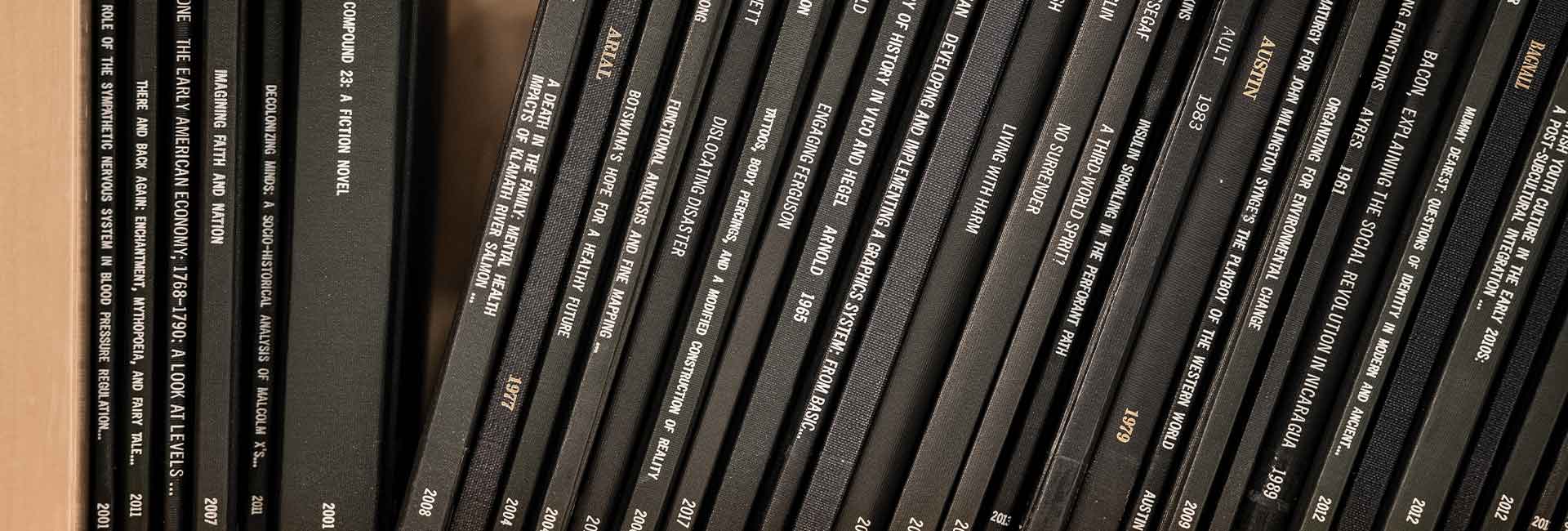
Tiptoe into the Allen Reading Room (a.k.a. the Quiet Room) in Penrose Library and you’ll see shelves lined with slim black volumes. These are the honors theses from Whitties going back to the Class of 1948, bound and displayed not just for posterity, but so they might inspire current students.
In some disciplines, students are required to file an application to pursue honors in their major, which must be approved by their supervising professor, before they can register for honors thesis. Qualifying students in majors that don’t require an application are automatically registered for honors after confirmation it’s been earned.
The criteria for earning honors in major study—something roughly 20% of Whitman students do—include a cumulative GPA of at least 3.3 on all credits earned at Whitman, a major GPA of at least 3.5, a pass with distinction on the senior assessment and an A- or higher on the senior thesis.

Quiet, please. Students read surrounded by senior theses in Penrose Library’s Quiet Room.
For students who complete their theses as part of a group, collaborating toward a common goal is a critical skill, though not always an easy one. But as Armstrong points out, even when team dynamics on projects are less than harmonious, students are gaining important human skills.
“The thesis class is someplace where students can learn what can go wrong in the context of collaborative settings and develop interpersonal skills like being able to maintain relationships while still being assertive about their needs,” Armstrong says.
He and his fellow thesis mentors agree another key learning experience for the senior project is learning to grapple with failure. Except for the type of failure that might result from not putting enough effort into a class project or test, students typically don’t encounter real failure in a classroom or lab setting, where projects are artificially designed to succeed.
“An important part of the scientific process is grappling with negative results. How do you interpret that, how do you write about it, how do you think through ‘OK, based on this data, what would these next steps be?’” Moss says. “I spend a lot of my time with students thinking through, if they are going to carry this project forward, what would they say the next steps would be, and how would they write about that in detail in their thesis.”
The Afterlife of the Senior Thesis
Seniors can showcase their thesis work for other students and faculty in the annual Whitman Undergraduate Conference (WUC). Over the course of a day, more than 100 students, mostly seniors, present their work as part of panels and poster sessions. No classes are held during the WUC so all students have the opportunity to participate.
{{4-left}}
Further afield, while students can tout their thesis experience in their graduate school applications or to employers, these projects often have surprising afterlives in other ways.
For example, one thesis project that Armstrong mentored ended up becoming part of a paper with other experiments from his Whitman psychology lab. The paradigm developed by the student was also picked up and used by another lab, in a pharmacological study.
“Sometimes these thesis projects end up having a real impact,” Armstrong says.
Likewise, Moss says her thesis students genuinely contribute to her own work. She’s published with student co-authors who have been involved in different aspects of an ongoing plant synthetic biology project.
{{5-right}}
“It’s so fun over the years to see where students are ending up and what kind of projects they’re working on,” she says. “Especially when I might be scanning the literature and come across a former student who’s an author on a paper.”
For Davies, the thesis experience has an emotional component too.
“Personally, it’s always bittersweet bidding farewell to seniors. It’s so great to see them grow, and then it’s so hard to say goodbye.”