

Meet Whitman’s New Faculty Fellows for 2026–2027
This year’s fellows bring unique perspectives on developmental biology, music and classics
By Lina Paykar ’29
Photography by Lizzett Zaragoza ’27

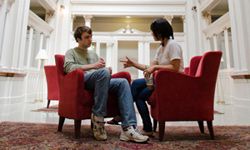
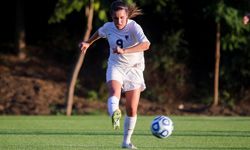
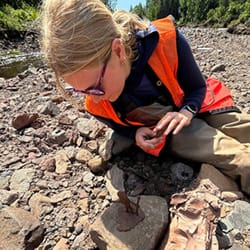
New voices on campus. Whitman’s 2026–2027 Faculty Fellows—(from left) Tashi Treadway, Alexandra Sjobeck and Elaine Kushkowski—are bringing fresh energy and perspectives to Whitman’s classrooms.
This year, Whitman College is pleased to welcome three new Faculty Fellows to campus.
The Faculty Fellows program aims to create a mutually beneficial environment where scholars who are early in their academic careers develop their teaching and research skills while introducing Whitman students to new areas of study. Fellows spend one academic year on campus, teaching courses, conducting research and filling in for faculty members on sabbatical.
This year’s Faculty Fellows include Elaine Kushkowski, Faculty Fellow in Biology; Alexandra Sjobeck, Faculty Fellow in Music; and Tashi Treadway, Faculty Fellow in Classics.
Elaine Kushkowski, Biology
Faculty Fellow in Biology Elaine Kushkowski is a developmental biologist who earned her undergraduate degree from Reed College and recently completed her doctorate at the University of Chicago, where she served as a Lead Graduate Fellow at the Chicago Center for Teaching and Learning.
In her role as a Lead Graduate Fellow, Kushkowski coordinated programming for graduate student instructors at the university. Now she is partnering with Whitman’s Center for Teaching and Learning to facilitate pedagogical workshops for campus instructors.
Kushkowski’s passion for embryology began during a college lab while watching fertilization under a microscope. Her doctoral research centered on creating a foundational “fate map” for zebrafish, tracing early embryonic cells to their ultimate roles in the adult organism.
At Whitman, Kushkowski is establishing a zebrafish research lab, where she will mentor student researchers investigating how head and jaw structures form. In her teaching, she says she prioritizes "persistent curiosity” and conceptual understanding over simple memorization.
This fall, Kushkowski is teaching Cell Biology (BIOL-272-A ST) and its associated lab. In the spring, she’ll oversee the Human Anatomy and Physiology I Lab (BIOL-221L-A) as well as an Animal Development (BIOL-224-A) course, which will walk students through early life processes, from initial cell division to cell separation.
“I really want students to show up as themselves and find ways to deeply engage and internalize what they are learning so it changes how they look at the world.
”

—Elaine Kushkowski, Faculty Fellow–Biology
Alexandra Sjobeck, Music
Faculty Fellow in Music Alex Sjobeck is a jazz pianist, composer and educator who brings a vibrant, multicity background to Whitman’s Music Department. Raised in rural Minnesota and Idaho, Sjobeck formally studied jazz at the Manhattan School of Music before earning her master’s degree at the University of Northern Colorado, after which she taught at Boise State University for five years.
Deeply committed to community engagement, Sjobeck co-founded Lala’s Jazz, a nonprofit that provides experiential learning for young artists, and directed the Gene Harris All-Stars, an after-school jazz education program for high-schoolers, while at Boise State.
Sjobeck views jazz as an immersive, spontaneous art form akin to painting. This semester, she directs Whitman’s Jazz Ensemble I (big band) and teaches The Anatomy of Jazz (MUS-260), a course linking jazz theory to cultural context and human experience.
Outside the classroom, Sjobeck is recording an album in Los Angeles featuring unconventional instrumentation, piano paired with two upright basses, to bridge jazz and classical traditions. Whitman students will get an inside look at the project later this year when Sjobeck hosts a campus master class with her collaborating bassist.
“Jazz isn’t traditional music to me. It’s more like looking at a painting. It only exists in the moment, and you have to be 100 percent absorbed to compose on the spot
”
—Alexandra Sjobeck, Faculty Fellow–Music
Tashi Treadway, Classics
Faculty Fellow in Classics Tashi Treadway explores human-animal relationships in ancient Greek and Latin literature, examining how ancient texts inform ethics and modern culture.
Treadway’s fascination with classical language began in middle school and continued through her doctoral studies, during which she led courses on ancient medicine, human-animal ethics, and disability studies. Treadway’s current research focuses on “one health,” a framework emphasizing the interconnected wellness of humans, animals and the environment and analyzing how modern medicine uses figures like Hippocrates to support public health policies.
At Whitman, Treadway is teaching Elementary Ancient Greek (GREK-105/106), incorporating spoken Greek techniques into grammar instruction, as well as Ancient Mythology (CLAS-130-A), in which students learn about the structures and functions of myth in ancient Greek and Roman cultures. Treadway’s mythology course honors ancient oral storytelling traditions by having students perform myths aloud rather than solely reading them.
This fall, Treadway is also collaborating with Department Chair Kate Shea, the Louis Francis Anderson Professor of Classical Literature and Archeology and Associate Professor of Environmental Humanities and Classics, on Whitman’s annual Odyssey Day (Oct. 15), which will feature interactive sessions on Homer’s epic.
“Myths were passed down orally around campfires before they were ever written down. Performing them aloud lets students engage with this tradition beyond the printed page.
”
—Tashi Treadway, Faculty Fellow–Classics